
He Hit His Ace on the River and Should Have Checked
My friend Donnie brought me a hand from a cruise ship game. He opened ace-ten suited, got heads up against a limpy recreational player, and flopped top pair, good kicker with the nut flush draw. It felt like his board the whole way. Then the river paired his ace, he bet, and the villain min-clicked him.
That hand is a perfect example of how players at fishy tables bleed money in spots they feel great about. Let's walk through it street by street.
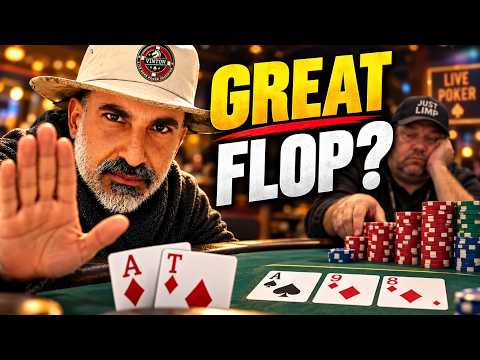

The Setup: Ace-Ten Suited at a Limp-Heavy Table
Stacks are 100 big blinds deep with a $5 big blind. Donnie is under the gun plus one, and the table has been limping a ton. He opens to $30. His reasoning was simple. When he opens to $15, everyone piles in. At $30, people start dropping off.
I liked the bet. Ace-ten suited leans slightly toward playing better multiway, because heads up it's dominated a lot of the time by the better aces. It folds around to a player Donnie had pegged as limpy, the kind of guy who limps with any ace. He calls, and they go heads up.
The Flop That Felt Like His Board
Donnie flops top pair with the nut flush draw. On this board he clearly has the range advantage, since he's the preflop raiser and holds far more aces than the villain. If eights and nines are in his opening range, he likely has the nut advantage too. This board smacks him hard.
Here's where it gets interesting. Two very common mistakes recreational players make are not betting for value and fearing too much. That means this villain can absolutely flat with ace-king, ace-queen, and even big pocket pairs, simply because he's scared of getting outdrawn.
Fish are very insensitive to price preflop. They want to see flops. But as the hand develops and more money goes in, especially on the river when there are no more cards to come, they become very price sensitive. That's elasticity versus inelasticity, and it's something you can use carefully at these tables.
Donnie bet nine big blinds into about thirteen and a half. It's not a huge mistake, but I'd go smaller, around four to five big blinds. Try to imagine a hand as bad as ten-eight with the ten of diamonds. Is he folding that to five big blinds? Definitely not. You want those hands in. Size up to nine, ten, eleven, and their fold frequency with that junk goes up, while you bloat the pot against the rare monster that has you crushed.
What a Passive Player's Call Tells You
Very little. Just because he didn't raise doesn't remove the strong hands from his range. At tables where the aggressive player gets treated like a pariah, a call only tells you he has something. The top of his range is still very much alive.
The Jack Turn: Good for Equity Isn't Good for the Money
The turn is a jack. Donnie felt good about it, because it gives him an open-ended straight draw to go with everything else. But think about it in terms of the villain's whole range. The only jack-seven that continued on the flop is jack-seven of diamonds. What the jack really adds is ace-jack, a hand that has Donnie crushed.
Donnie's equity was built on top pair, good kicker and the nut flush draw. The jack added a few straight outs, but it also added more combos to the villain's range that beat him if he doesn't improve. Net effect, it's not a great card. He bet twelve into thirty-one and a half, about 40% pot. That's fine. I might even go as low as 30%, but never above twelve. You just want his worse hands to keep coming along.
The River Ace: The Real Decision Point
The river pairs the ace, and Donnie felt even better. That's the trap. Instead of thinking "jackpot," flip the question around. What hands am I trying to get value from, and what hands am I value-owning myself against?
The value side is ace-deuce through ace-seven. That's about it. On the other side you have ace-eight, ace-nine, ace-jack, ace-queen and ace-king, all of which have you crushed, with ace-ten as a chop. When you actually weigh those two sides, the scale tips hard against you.
Now look at your sizing options. If you jam, you only get called by hands that beat you. If you bet one to five big blinds, a passive player might still find a raise with his monsters. Conservatively, call that 20% of the time, and that's not negligible. The question becomes whether there's a size somewhere in between that gets called by worse often enough without getting raised by better. In this hand, I can't confidently find one. So I'm check-calling.
Facing the Min-Click
Donnie bet twelve, about a quarter of the pot, and the villain min-raised. Now he's looking at twelve big blinds into a pot of more than ninety, and the math screams call. That's exactly how players bleed money hand after hand. Against this player, a min-click on the river is the nuts or close to it the vast majority of the time. Recreational players almost never find bluffs here.
That's a sad muck. Sure, you might get bluffed 5% of the time, and I'm being generous. That's okay. Donnie called, and the villain showed ace-queen.
And think about the image a strong fold builds. You're going to be sitting at that table for another six or seven hours. Let that muck speak for you and set the path for future hands. This is a people's game played with cards, not a card game played with people.
The Scariest Player at the Table
Years ago I worked outside Kinshasa in the Congo, and one of the scariest moments of my life was coming across a group of armed kids. You can reason with grown men who know what they're doing. You can't reason with chaos. Playing against drunk, happy players who've never studied the game feels a lot like that. They don't know what they don't know.
Imagine playing your four-year-old for real money. What's the strategy? Protect yourself. At these tables, that means keeping pots small until you have a tight grip on the hand, and respecting the river when the money finally gets big.
Have you been in a spot like this? Come share your take with the rest of the crew.

How Do You Get Faster at Narrowing Ranges?
That was Donnie's big question, and it's the same one I asked myself years ago. When I came back to the tables after a four-year break, I was barely breaking even. Most of the material I found taught me what to do in very specific spots that almost never repeat. Solvers tell you what to do, but they don't tell you how they think, and against real people, unexploitable doesn't automatically mean profitable.
The answer comes down to two things. First, collect as many data points on your opponents as you can, as accurately as you can. One accurate data point is useless, and a pile of inaccurate ones is useless too. Second, run that data through a repeatable thought process built on math. Equity, frequency and probability give you EV, and math doesn't change. It was true twenty years ago and it'll be true fifty years from now.
That process has to become so automatic that it doesn't drain you. When I first rebuilt my game this way, I went from playing 36-hour sessions to being exhausted by hour six. You get used to it, and those six hours become far more profitable than the 36 ever were.
Precision In, Profits Out
Get the precision in part right. Good data, gathered accurately, run through a repeatable math-based process. The profits out part is just playing long enough to realize your equity. If every decision you make averages plus EV, it doesn't matter whether you win or lose any single hand.
If you want help building that process with your own hands, I offer a free one on one coaching session where we can look at your game together and find the leaks costing you money.
Keep crushing out there, and reach out anytime if you want to talk through a hand of your own.
Precision In. Profits Out.
